

Do you usually head straight to the first tee without warming up? Taking a few minutes to prepare your body before playing golf can make a difference in how comfortably you move and swing throughout your round. Golf involves more than swinging a club. Each shot requires coordination between your shoulders, upper back, core, hips, and legs. Your body also needs to rotate, maintain balance, and transfer weight smoothly. Without enough preparation, these movements may feel restricted, especially when you have been sitting for a long time or have not played recently.
In this guide, you will find golf warm up exercises to help improve mobility, activate the muscles used during play, and prepare your body for your next round. You will also learn how long to warm up and what to do before your first shot.
Why Are Golf Warm Up Exercises Important?
Golf warm up exercises help prepare your body for the repeated rotation, balance, and controlled movement involved in a golf swing. Rather than starting with powerful shots immediately, a warm-up allows you to gradually increase your movement and get familiar with the motions required during play.
Here are several reasons to include a warm-up in your pre-round routine.
- Prepare Your Muscles for Movement
A golf swing involves several muscle groups working together. Your shoulders, arms, back, abdominal muscles, hips, and legs all contribute to the movement. A gradual warm-up increases physical activity before you start making full swings. It also helps you move from a resting state into the more demanding movements required during a round. - Improve Mobility and Range of Motion
Golf requires rotation through the upper body and hips. If these areas feel stiff, you may find it harder to move comfortably into your backswing and follow-through. Dynamic mobility exercises take your joints and muscles through controlled movements. This can help you explore the range of motion needed for your swing without forcing your body into uncomfortable positions. - Activate Your Core and Lower Body
Your golf swing depends on more than your arms. The core and lower body help you maintain posture, control rotation, and transfer weight between your feet. Exercises such as squats, lunges, and hip movements activate these areas before you start playing. - Build Coordination Before Your First Shot
A consistent golf swing requires timing and coordination between different parts of your body. A warm-up gives you an opportunity to practise controlled movements before adding the speed and force of a full swing. It can also help you become more aware of your balance, posture, and movement rhythm.
Golf Warm-Up Exercises to Try Before Playing

You do not need a full gym setup to prepare for a round of golf. Most of the following exercises can be performed while standing, and a few only require a golf club for support or added movement. Start slowly, keep your movements controlled, and perform each exercise on both sides where applicable. Adjust the range of motion to your comfort level.
1. Arm Circles
Arm circles are a simple way to get your shoulders moving before practising your swing. They are particularly useful if your shoulders feel stiff after sitting at a desk or driving to the golf course.
How to do it:
- Stand upright with your feet shoulder-width apart.
- Extend both arms out to your sides at shoulder height.
- Make small forward circles with your arms.
- Gradually increase the circle size while keeping your shoulders relaxed.
- Reverse the direction and repeat.
Recommended repetitions: 10 circles forward and 10 circles backward.
This exercise helps prepare your shoulders for the arm movement involved in a golf swing.
2. Standing Torso Rotations
Torso rotations prepare your upper body for the turning movement used during your backswing and follow-through. They also encourage controlled rotation through your trunk.
How to do it:
- Stand with your feet slightly wider than hip-width apart.
- Bend your elbows and place your hands lightly across your chest.
- Keep your hips facing forward.
- Slowly rotate your upper body to the right.
- Return to the centre and rotate to the left.
- Continue alternating without forcing the movement.
Recommended repetitions: 10 rotations on each side.
Keep your movements smooth and avoid twisting beyond your comfortable range of motion.
3. Golf Club Shoulder Mobility
You can use your golf club to help mobilise your shoulders and upper body before swinging. This movement also encourages an upright posture and controlled arm positioning.
How to do it:
- Stand upright and hold your golf club horizontally with both hands.
- Position your hands slightly wider than shoulder-width apart.
- Slowly raise the club in front of your body and overhead, as far as comfortable.
- Lower it back to the starting position.
- Repeat the movement without arching your lower back.
Recommended repetitions: 8 to 10 times.
If raising the club overhead feels uncomfortable, reduce the range of motion. The goal is to prepare your shoulders, not force a stretch.
4. Hip Circles
Your hips play an important role in maintaining balance and controlling rotation during a golf swing. Hip circles help introduce gentle movement to this area before you start playing.
How to do it:
- Stand with your feet slightly wider than hip-width apart.
- Place your hands on your hips.
- Slowly move your hips in a circular direction.
- Complete several circles, then reverse the direction.
- Keep your upper body relatively steady.
Recommended repetitions: 8 to 10 circles in each direction.
Move at a comfortable pace and avoid making sudden or exaggerated movements.
5. Leg Swings
Leg swings are dynamic mobility exercises that prepare your hips and legs for movement. They can be especially useful before walking around the course or practising weight transfer during your swing.
How to do it:
- Stand beside a stable surface, such as a golf cart or wall, for support.
- Place one hand on the surface to maintain balance.
- Swing one leg gently forward and backward.
- Keep your upper body upright and avoid leaning excessively.
- Switch legs and repeat.
Recommended repetitions: 10 swings per leg.
Start with a small range of motion and increase it gradually as your legs become more comfortable.
6. Bodyweight Squats
Bodyweight squats activate your thighs, glutes, and core. These muscles help support your posture and balance throughout a round of golf.
How to do it:
- Stand with your feet approximately shoulder-width apart.
- Keep your chest lifted and your back in a comfortable neutral position.
- Bend your knees and push your hips backward as if sitting on a chair.
- Lower yourself only as far as comfortable.
- Push through your feet to return to a standing position.
Recommended repetitions: 8 to 10 squats.
Avoid letting your knees collapse inward. Keep the movement controlled rather than dropping quickly into the squat.
7. Standing Hip Hinge
A hip hinge helps you practise bending from your hips while maintaining a stable back position. This movement is relevant to the posture you use when addressing the golf ball.
How to do it:
- Stand with your feet hip-width apart.
- Place your hands on your hips or across your chest.
- Keep your knees slightly bent.
- Push your hips backward while leaning your upper body forward.
- Maintain a comfortable, neutral spine.
- Return to a standing position by bringing your hips forward.
Recommended repetitions: 8 to 10 times.
Focus on moving through your hips rather than rounding your back. You do not need to bend very far to perform this exercise correctly.
8. Reverse Lunges
Reverse lunges activate your legs and glutes while challenging your balance. They also introduce a controlled stepping movement that can help prepare your lower body for weight shifts during a golf swing.
How to do it:
- Stand upright with your feet hip-width apart.
- Step one foot backward.
- Bend both knees slightly as you lower your body.
- Keep your front knee aligned with your foot.
- Push through your front foot to return to the starting position.
- Repeat with the other leg.
Recommended repetitions: 6 to 8 times per leg.
If you find it difficult to maintain balance, hold a stable surface for support. You can also reduce how far you step backward.
9. Wrist Rotations
Your hands and wrists help you control the golf club throughout the swing. Wrist rotations are a simple way to introduce gentle movement before gripping the club and practising your shots.
How to do it:
- Extend both arms in front of your body.
- Relax your hands and make gentle circular movements with your wrists.
- Rotate in one direction several times.
- Reverse the direction.
- Keep your forearms relatively still while moving your wrists.
Recommended repetitions: 10 rotations in each direction.
Avoid forcing your wrists into an uncomfortable position. The movement should feel gentle and controlled.
10. Controlled Practice Swings
Once you have completed the mobility and activation exercises, move on to a few slow practice swings. This final step helps connect your warm-up movements with the actual golf swing.
How to do it:
- Hold your golf club with your usual grip.
- Set up in your normal golf stance.
- Make a slow backswing without trying to generate maximum power.
- Move smoothly through the downswing and follow-through.
- Repeat while paying attention to your balance and posture.
- Gradually increase your swing speed if the movement feels comfortable.
Recommended repetitions: 5 to 10 controlled swings.
Start with a shorter swing before progressing to a fuller movement. Avoid hitting the ball at full power immediately after finishing your mobility exercises.
Read more: How Driving Range Golf Improve Health and Well-Being? The Wellness Benefits of Regular Golf Practice
How Long Should You Warm Up Before Playing Golf?
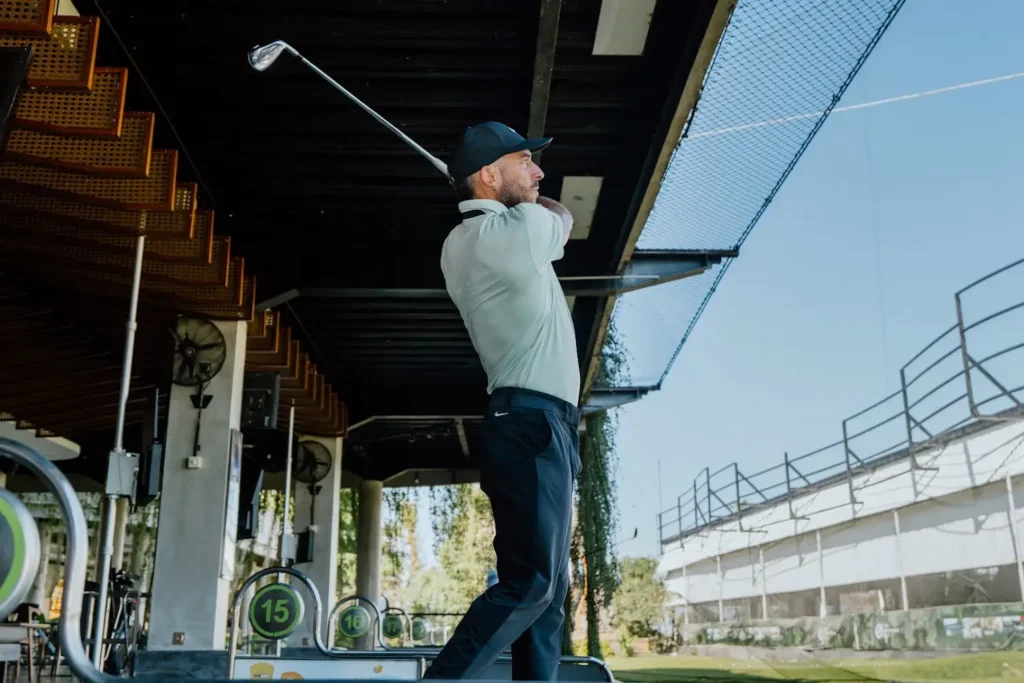
A practical golf warm-up can take around 10 to 15 minutes, depending on your fitness level, mobility, and how much time you have before your tee time. You do not need to spend the same amount of time on every movement. Focus on gradually preparing your body rather than rushing through the exercises.
You can organise your routine into three stages:
| Warm-up stage | Suggested duration | What to do |
| General movement | 2–3 minutes | Walk at a comfortable pace or march in place |
| Dynamic mobility and activation | 5–7 minutes | Perform shoulder circles, torso rotations, hip circles, leg swings, and lower-body exercises |
| Golf-specific preparation | 3–5 minutes | Practise controlled swings and gradually increase swing speed |
These timings are practical guidelines, not strict requirements. You can adjust them depending on how your body feels and the time available. If you have been sitting for several hours before arriving at the course, you may need a little more time to move comfortably. On the other hand, if you already feel mobile and active, a shorter routine may be sufficient. The important point is to avoid going directly from rest to repeated full-power swings. Give your body time to adjust to the movements you are about to perform.
What Should You Do After Your Golf Warm-Up?
After completing your golf warm-up exercises, spend a few minutes practising with your clubs before starting your round. This helps you transition from general body preparation to the specific movements involved in hitting the ball.
Here is a simple progression you can follow:
- Start With Short Irons or Wedges
Begin with a pitching wedge or another short iron. Make a few half-swings and focus on contact, balance, and tempo. Starting with shorter clubs allows you to practise your swing without immediately trying to generate maximum distance. - Gradually Move to Longer Clubs
Once you feel comfortable, move on to mid-irons and longer clubs. Increase your swing length and speed gradually rather than making full-power swings from the beginning. This progression also gives you time to become familiar with your timing and ball contact. - Practise Different Types of Shots
If you have enough time, try a few different shots, such as shorter approaches, longer shots, and controlled drives. This helps you prepare for the variety of situations you may encounter on the course. You do not need to hit a large number of balls. A few purposeful practice shots can be more useful than rushing through a bucket without a clear focus. - Check Your Balance and Swing Rhythm
Pay attention to how your body moves during each swing. Notice whether you can maintain your posture, rotate comfortably, and finish in a balanced position. If a movement feels uncomfortable, reduce your swing intensity rather than trying to force it.
Common Golf Warm-Up Mistakes You Should Avoid
Even if you understand the importance of warming up, certain habits can make your routine less effective. Keep these common mistakes in mind before your next round.
- Skipping the Warm-Up Entirely
Going straight from your car or office to the first tee means your body has little time to adjust to the movements involved in golf. Even a short routine with a few dynamic exercises is a better starting point than immediately making full swings. - Starting With Full-Power Driver Swings
Your driver is designed for long-distance shots, but that does not mean it should be the first club you use during practice. Start with shorter, controlled swings and gradually progress to longer clubs. This gives you time to establish your rhythm before increasing swing intensity. - Focusing Only on Your Upper Body
Golf involves coordinated movement throughout your body. Preparing only your shoulders and arms leaves out important areas such as your hips, legs, and core. Include both upper-body mobility and lower-body activation in your routine. - Relying Only on Static Stretching
Holding a stretch in one position can be useful for flexibility, but it should not be the only activity in your pre-round routine. Dynamic movements are generally more suitable for preparing the body for an activity that involves repeated movement. A systematic review of golf warm-ups also found that dynamic and resistance-based warm-ups tended to support performance, while static stretching alone was less favourable in the studies reviewed. However, the evidence linking warm-up habits directly to golf injury prevention remains mixed and inconclusive. - Ignoring Pain or Discomfort
A warm-up should prepare your body, not cause pain. If an exercise creates sharp pain, unusual discomfort, or dizziness, stop rather than pushing through it. You can modify the movement or leave it out. If discomfort persists or affects your ability to play, consider seeking advice from a qualified healthcare professional.
Read more: Golf Driving Range Warm Up Routine for Better Performance
Improve Your Golf Skills at Bali International Golf
Preparing your body before a round of golf does not have to be complicated. A consistent routine of dynamic mobility exercises, muscle activation, and controlled practice swings can help you feel more prepared for the movements involved in the game. Start with simple exercises, pay attention to your range of motion, and gradually increase your swing intensity. Most importantly, choose movements that feel comfortable and suit your current fitness level.
If you are looking for a place to practise, visit Bali International Golf and explore our driving range, Toptracer technology, training programmes, and other facilities. Make your next golf session a good opportunity to work on your swing and enjoy the game.