

A consistent golf swing can help you hit the ball more accurately, control its trajectory, and build confidence every time you step onto the driving range or golf course. However, learning how to improve your golf swing is not simply about hitting the ball harder. It involves developing the right fundamentals, understanding how your body moves, and practising techniques that make your shots more predictable.
Whether you are picking up a golf club for the first time or trying to overcome inconsistent ball striking, small adjustments can make a meaningful difference. The good news is that you do not need a perfect swing to start making progress. With focused practice, useful feedback, and a structured approach to learning, you can gradually improve your technique. In this guide, you will discover practical golf swing tips, beginner-friendly drills, common mistakes to avoid, and ways to develop your skills through driving range practice and professional golf training.
How to Improve Your Golf Swing
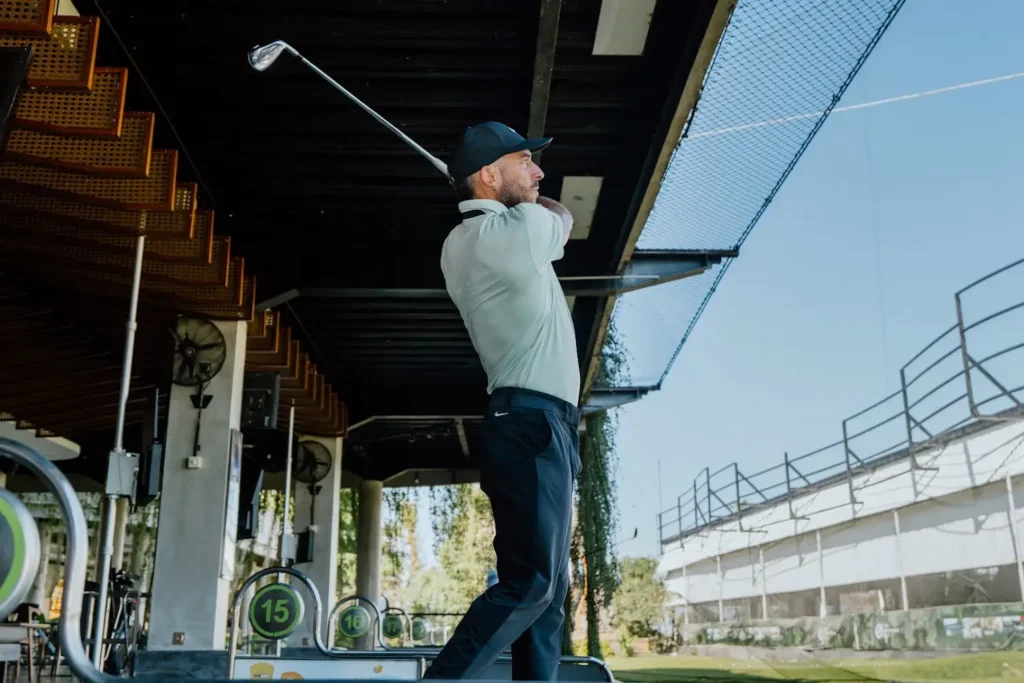
Here are the essential steps you can follow to improve your golf swing, from mastering the fundamentals to practising targeted drills and getting professional guidance. These practical tips will help you build a more consistent technique, improve ball contact, and develop confidence with every driving range session.
1. Start With the Fundamentals of a Good Golf Swing
The first step in learning how to improve your golf swing is to establish a reliable setup, including your grip, stance, posture, and alignment. These fundamentals influence how comfortably you can move the club and how consistently you can strike the ball.
Get Your Golf Grip Right
A proper golf grip helps you control the clubface throughout your swing. Since your hands are your only direct connection to the club, the way you hold it can influence the direction and quality of your shots. To establish a basic grip, place the club handle primarily across the fingers of your lead hand rather than deep in your palm. Your lead hand is your left hand if you play right-handed and your right hand if you play left-handed. Then, position your other hand so both hands work together as a unit.
You can use an overlapping, interlocking, or ten-finger grip, depending on your comfort and what your instructor recommends. More importantly, avoid gripping the club so tightly that your forearms become tense. Excessive tension can restrict comfortable movement and make it harder to maintain a smooth swing.
Practice tip: Before hitting a ball, take a few practice swings while paying attention to your grip pressure. Aim for a secure but relaxed hold that allows you to control the club without squeezing unnecessarily.
Improve Your Golf Stance and Posture
Your golf stance provides the foundation for balance and rotation during the swing. A stable stance allows you to move naturally without feeling as though you might fall forward, backward, or sideways. Start by standing with your feet approximately shoulder-width apart when using a mid-iron. Slightly flex your knees and bend forward from your hips, keeping your back in a comfortable, relatively neutral position. Let your arms hang naturally beneath your shoulders rather than reaching too far toward the ball.
Your stance width and posture may change depending on the club. For example, a driver generally calls for a wider stance than a wedge, while the ball position also changes according to the shot you want to play. Avoid bending excessively at the knees or rounding your back. Instead, aim for a balanced athletic position that allows you to rotate your torso without losing stability.
Check Your Alignment Before Every Shot
Correct alignment helps you aim the clubface and your body toward the intended target. Even when your swing mechanics are reasonably consistent, poor alignment can cause shots to finish away from where you expect. Choose a specific target before addressing the ball. First, position the clubface so it points toward your intended starting line. Next, align your feet, hips, and shoulders approximately parallel to that line, adjusting as needed for the shot.
An alignment stick or spare golf club placed on the ground can help you check your setup during practice. However, make sure it is positioned safely and does not interfere with other players. Developing a consistent pre-shot routine makes this process easier. Once you have selected your target and checked your alignment, you can focus on executing the swing rather than making last-second adjustments.
2. Build a Smooth and Repeatable Golf Swing
A repeatable golf swing is more useful than a powerful swing you can only produce occasionally. Once your setup becomes more consistent, focus on making a controlled backswing, transitioning smoothly into the downswing, and finishing in balance.
Control Your Backswing
The backswing prepares your body and club for the movement toward the ball. Instead of immediately pulling the club back with your hands, allow your shoulders and torso to turn naturally while maintaining a stable base. Your range of motion will depend on your flexibility, experience, and physical comfort. You do not need to force your body into a particular position or copy the backswing of a professional golfer.
For beginners, a shorter, controlled backswing can be a useful starting point. It allows you to concentrate on balance, club control, and solid contact without worrying about producing maximum distance. Try making several slow practice swings without a ball. Notice whether you can turn comfortably while keeping your balance and maintaining control of the club.
Develop Better Swing Tempo
Golf swing tempo refers to the rhythm and timing of your swing. A smoother tempo can help you coordinate your movements, whereas rushing from the top of the backswing can make it harder to control the clubface and strike the ball consistently. Remember that smooth does not necessarily mean slow. The objective is to coordinate the backswing and downswing rather than abruptly accelerating or trying to hit the ball as hard as possible.
One useful exercise is to count quietly during your practice swing. For example, count during the backswing and transition into the downswing without pausing unnaturally at the top. You can also make a few rehearsal swings before hitting each ball. As your timing improves, you may find it easier to repeat your swing under different conditions. Focus on rhythm first, then gradually introduce more speed while maintaining control.
Learn to Rotate Without Losing Balance
A golf swing involves coordinated movement through the hips, torso, shoulders, arms, and hands. Effective rotation helps you generate clubhead speed while maintaining control, but forcing extra rotation does not automatically produce better shots. During the backswing, allow your shoulders and torso to turn naturally. As you move into the downswing, your body and arms should work together to bring the club toward the ball. After impact, continue rotating into a balanced finish rather than stopping your movement abruptly.
Avoid deliberately sliding your hips sideways or trying to twist your body beyond its comfortable range. These movements can make your swing harder to control and may create unnecessary physical strain.
Practice tip: Make half swings with a short iron while focusing on balance and solid contact. Once these feel comfortable, gradually increase the length of your swing without sacrificing control.
Finish in a Balanced Position
Your follow-through provides useful feedback about the quality of your movement. Although a balanced finish does not guarantee a perfect shot, repeatedly losing your balance may indicate that you are swinging too aggressively or struggling to coordinate your movements. After hitting the ball, allow the club to continue moving naturally around your body. Finish with your weight predominantly on your lead side, your body facing more toward the target, and your feet stable.
Hold the finishing position for two or three seconds after each practice shot. If you cannot remain balanced, reduce your swing speed and focus on a more controlled movement. Over time, this simple habit can help you develop greater awareness of your body position and swing rhythm.
Read more: Beginner Friendly Golf in Bali: Where to Play for a Smooth Start!
3. Practise Golf Swing Drills That Target Specific Skills
Golf swing drills help you turn general advice into repeatable movements. Instead of hitting dozens of balls without a clear objective, choose exercises that address a particular issue, such as alignment, balance, or consistent contact.
The Alignment Drill for More Accurate Shots
The alignment drill helps you establish a reliable target line before swinging. It is particularly useful if your shots frequently start in the wrong direction despite feeling comfortable with your swing. Place one alignment stick along your intended target line and another parallel to it, near your feet. Check that the clubface points toward the target while your body is aligned appropriately alongside the target line.
Hit a small number of balls using a short or mid-iron, checking your setup before every shot. Once the alignment feels consistent, remove the sticks and see whether you can reproduce the same routine. This exercise trains you to separate aiming errors from swing errors. That distinction matters because changing your swing mechanics will not necessarily fix a shot that starts offline because of poor alignment.
The Half-Swing Drill for Better Ball Contact
The half-swing drill helps you focus on controlling the club and making consistent contact before attempting a full swing. It is especially helpful for beginners who struggle to hit the ball cleanly. Start with a wedge or short iron and make a compact backswing. Swing through the ball using a comfortable rhythm, then finish with a short, balanced follow-through.
Focus on where the club contacts the ball and how the shot travels rather than how far it goes. If you repeatedly hit the ground too early or make inconsistent contact, slow down and shorten the movement further. Once you can produce several controlled shots, gradually increase the swing length. This progression helps you build a foundation for fuller swings without introducing too many technical changes at once.
The Feet-Together Drill for Balance and Coordination
The feet-together drill encourages you to develop a sense of balance during the golf swing. Because your stance is narrower than usual, excessive swaying or uncontrolled movement becomes easier to notice. Take a short iron and bring your feet close together. Begin with gentle half swings, concentrating on maintaining your balance before and after impact.
You do not need to hit the ball far during this exercise. Instead, pay attention to the quality of contact and whether you can finish without stepping away from your original position. After several repetitions, return to your normal stance and compare how the movement feels. If the drill is uncomfortable or causes you to lose control, widen your stance slightly or return to slower practice swings.
The Tempo Drill for a More Consistent Rhythm
The tempo drill helps you develop a repeatable rhythm without trying to manufacture extra power. It can be particularly helpful if you tend to rush the downswing or tense your arms when approaching the ball. Start with a few rehearsal swings without a ball. Use a comfortable rhythm, allowing the backswing to flow into the downswing instead of making a sudden change in direction.
Next, hit a small number of balls using the same rhythm. Alternate between rehearsal swings and actual shots so that you focus on reproducing the movement rather than chasing distance. If your contact becomes inconsistent, reduce your swing length and speed. Once the rhythm feels natural, gradually increase your effort while maintaining a balanced finish.
4. Understand Common Golf Swing Problems and How to Fix Them
Understanding common golf swing problems helps you choose the right correction instead of changing several parts of your technique at once. The key is to identify a recurring pattern, test a simple adjustment, and observe whether your ball flight improves.
How to Reduce a Golf Slice
A golf slice is a shot that curves significantly to the right for a right-handed golfer or to the left for a left-handed golfer. It often occurs when the clubface is open relative to the club’s swing path at impact. Start by checking your grip and alignment. An excessively weak grip or an aim that encourages a leftward swing path for a right-handed player may contribute to the problem, although the cause varies between golfers.
Rather than attempting to fix everything at once, begin with a setup check and observe the initial direction and curvature of your shots. A qualified golf instructor can help you determine whether the main issue involves the clubface, swing path, or a combination of factors. Avoid simply trying to swing harder or deliberately flipping your hands through impact. These adjustments can make your ball flight less predictable if they do not address the underlying cause.
How to Improve Golf Swing Accuracy
Improving golf swing accuracy starts with consistent alignment, controlled tempo, and repeatable contact. You do not necessarily need to swing faster or make a major technical change to hit more predictable shots. Choose a target and record where your shots start and finish. For example, notice whether the ball consistently starts left, starts right, or begins on the intended line before curving away.
These observations help you distinguish between directional errors and curvature. They also give you useful information to discuss with a coach. During practice, use a specific target rather than aiming vaguely at the centre of the range. Your objective is to build a repeatable process that improves your ability to control the starting direction and shape of your shots.
How to Generate More Distance Without Forcing Your Swing
Increasing golf swing distance involves several factors, including clubhead speed, centred contact, equipment, and the conditions in which the ball is struck. Trying to generate more power by using excessive force can undermine consistency. Begin by improving your contact and balance. If you frequently strike the ball away from the centre of the clubface, improving contact may be more useful than immediately trying to increase swing speed.
Once your technique is reasonably consistent, you can work on producing speed through coordinated movement and appropriate physical conditioning. Mobility, strength, and balance exercises may support your ability to swing comfortably, but they should match your fitness level and physical limitations. Remember that distance is not the only measure of improvement. More predictable ball flight and better control can make your overall game more effective, even before you achieve significant gains in yardage.
Read more: How Long Do You Practice at the Driving Range for Better Golf Skills? Find Out Here!
5. Create a Structured Golf Driving Range Practice Routine
A structured driving range practice routine helps you apply golf swing tips consistently instead of hitting balls without a clear plan. Each session should have a specific objective, a manageable number of drills, and time to review your results.
Warm Up Before Hitting Full Shots
A short warm-up prepares your body for the movements involved in golf. Begin with gentle walking, comfortable shoulder rotations, torso turns, and other dynamic movements that suit your mobility. Next, make several practice swings without a ball. Start with small movements and gradually increase the range of motion as you feel more comfortable.
Avoid beginning with maximum-effort driver swings when your body is still stiff. Instead, start with a wedge or short iron and gradually progress toward longer clubs. If you experience pain, stop the activity and seek appropriate professional advice rather than trying to swing through it.
Use This 45-Minute Practice Plan
A 45-minute session can help you work on several aspects of your golf swing without losing focus. Adjust the duration according to your experience, energy, and training goals.
| Practice stage | Duration | Main objective |
| Warm-up and rehearsal swings | 5 minutes | Prepare your body and establish a comfortable rhythm |
| Grip, stance, and alignment | 10 minutes | Build a consistent setup with a wedge or short iron |
| Half-swing and contact drills | 10 minutes | Improve control and strike quality |
| Tempo and balance practice | 10 minutes | Develop a repeatable swing rhythm |
| Target practice and review | 10 minutes | Check direction, consistency, and progress |
You do not need to follow this schedule rigidly. For instance, if you are new to golf, you may benefit from spending more time on your grip and posture. Meanwhile, a more experienced player might dedicate additional time to diagnosing a persistent ball-flight pattern. The important point is to practise with intention. Before moving to the next exercise, identify what you are trying to improve and what feedback will tell you whether the drill is helping.
Track Your Progress Between Sessions
Tracking your progress allows you to see whether your practice is producing meaningful improvements. Rather than recording distance alone, pay attention to how often you make solid contact, maintain balance, and send the ball toward your intended target. You can keep simple notes on your phone after each session. Record the club you used, the drill you practised, the common mistake you noticed, and one thing you want to work on next time.
If you record your swing on video, use the footage to compare your setup and overall movement over time. Avoid trying to diagnose every technical detail yourself, particularly if you are still learning the fundamentals. Consistent practice and useful feedback are generally more productive than repeatedly changing your technique after watching unrelated swing tips online.
6. Get Professional Golf Training to Improve Your Swing Faster

Professional golf training can help you identify swing problems, receive individual feedback, and follow a structured plan based on your current ability. While independent practice is valuable, a qualified instructor can help you understand which adjustments are most relevant to your goals. A golf lesson can focus on fundamental skills such as grip, posture, alignment, ball contact, and swing rhythm. As your technique develops, training can progress toward more specific goals, including reducing a slice, improving distance control, or preparing for on-course play.
Professional coaching is especially useful when you have been practising regularly but continue to experience the same problem. Instead of guessing which adjustment might work, you can work with an instructor to assess your movement and develop a manageable practice plan.
Choose a Training Programme That Matches Your Skill Level
The right golf training programme should reflect your experience, goals, and preferred learning environment. Beginners often benefit from learning the fundamentals in a structured setting, while more experienced golfers may prefer targeted sessions addressing specific weaknesses. Before starting, consider what you want to achieve. You might want to learn how to hold a club, develop a consistent swing, improve your ball striking, or become more confident at the driving range. It is also worth discussing your goals with the instructor so that your sessions focus on practical improvements rather than too many technical adjustments at once.
At Bali International Golf, the training programmes include options for different learning needs, including training packages, couple and family programmes. The facility also states that its professional coaches are certified and registered with PGA Indonesia. These options provide a starting point for golfers who want structured guidance while developing their skills.
Practise Your Golf Swing at Bali International Golf
Learning how to improve your golf swing takes consistent practice, a solid understanding of the fundamentals, and the patience to refine your technique over time. By improving your grip, stance, alignment, and swing tempo, practising targeted drills, and identifying common mistakes, you can develop more consistent ball striking and greater control. Following a structured driving range routine and seeking professional feedback when needed can also help you track your progress and work towards your golf goals.
At Bali International Golf, you can put these techniques into practice at a driving range featuring 40 regular bays, providing space to work on your swing, ball contact, and accuracy. Whether you are a beginner learning the basics or a more experienced golfer looking to refine your technique, you can also explore our golf training programmes for structured guidance from professional coaches. Contact us and book your session at Bali International Golf to practise your golf swing, build confidence, and continue developing your skills in Bali.